
Manufacturing the Prophet & The Built-in Authority
The View from the Media Suite
During my years at the Manhattan headquarters of The Epoch Times, the figure of Li Hongzhi hovered over every desk, story meeting, and marketing strategy. We did not speak his name casually. Staff referred to him simply as “Master” or “Teacher”, often in hushed, reverent tones. In our open-plan offices on West 27th Street, his portraits hung discreetly, and his latest directives were treated as cosmic law rather than administrative guidance.
In those early days as Global Marketing Director, I quickly learned the unspoken boundaries of our newsroom. You could critique the Chinese Communist Party with relentless fervor, dissect global geopolitical trends, or pitch complex promotional campaigns. But you never, under any circumstances, scrutinised Master Li’s biography, his childhood claims, or the origins of his authority. To express even mild skepticism about his personal history was not viewed as healthy editorial independence. It was treated as a dangerous spiritual failing, a sign that karmic debt or evil interference was corrupting your mind and threatening your salvation.
We built our entire external branding on the concept of Zhen (Truthfulness). Yet inside the movement, we were trained to ignore the glaring historical contradictions at the very foundation of our faith.
The Altered Origin Story and the 1994 ID Forgery
Every high-control movement relies on a carefully constructed origin myth that elevates its founder above ordinary human limitations. In the earliest printed editions of Falun Gong’s foundational text, Zhuan Falun (published in December 1994), the book opened with a short, miraculous biography of Li Hongzhi.
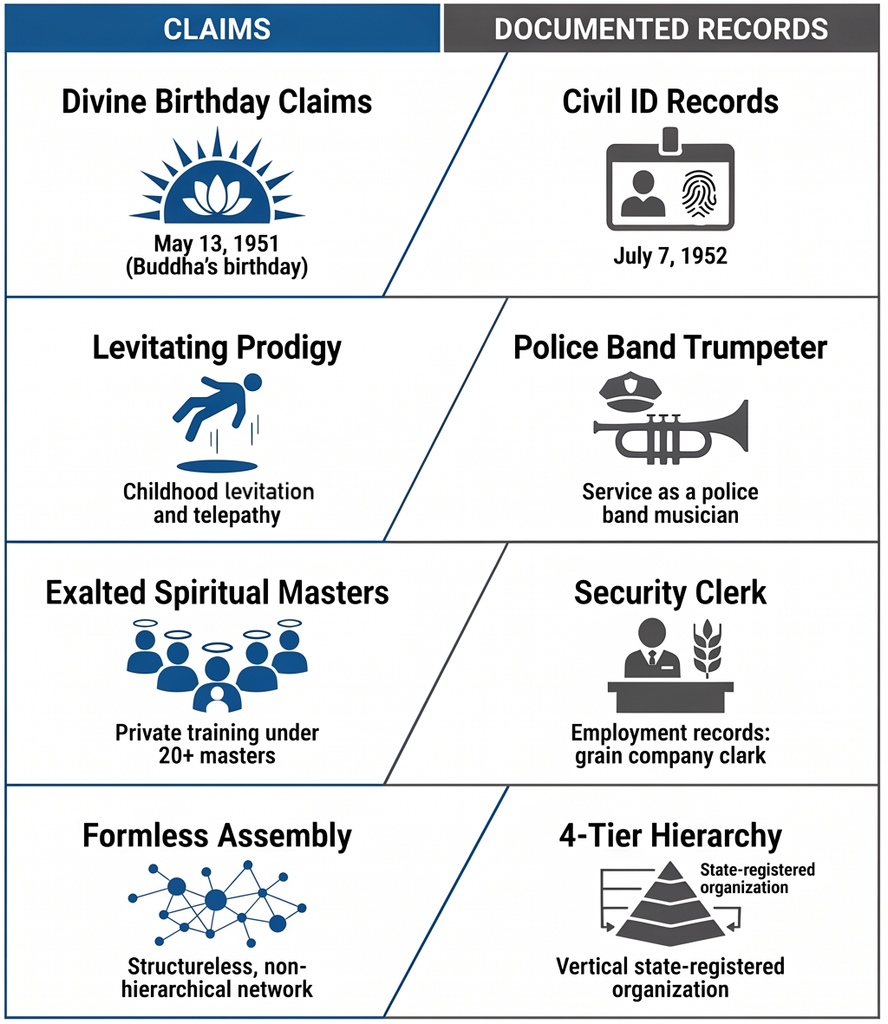
This official hagiography claimed that Li was born on 13 May 1951 in Gongzhuling, Jilin Province. It asserted that at just four years of age, he received secret instruction from Quan Jue, a master of the Buddhist School, who imparted the core truths of the Universe. By age eight, the biography claimed, he had attained supernormal powers: he could levitate, render his body invisible, read minds, control the movements of others, and see into the future. The text went on to state that throughout his youth, he was trained by Baji Zhenren, a master from the Taoist School, alongside more than twenty other spiritual masters, absorbing ancient wisdom before introducing Falun Dafa to the public in 1992.
When independent journalists, academic researchers, and municipal authorities examined government civil archives after 1999, however, a thoroughly secular life story came to light. Original household registration (hukou) records, school registries, military personnel files, and employment rosters confirmed that he was born Li Lai on 7 July 1952.
Former primary and secondary school teachers in Changchun remembered him as an entirely ordinary boy who displayed no unusual talents or levitation skills. His military commanders noted that his primary contribution during his service in the forest police band between 1972 and 1978 was playing the trumpet. Following his military discharge, he worked as a guest house attendant and later spent nearly a decade as a security clerk for the Changchun Cereals and Oil Company from 1982 to 1991, before taking commercial Qigong classes in 1988.
The difference between a July 1952 birthdate and a May 1951 birthdate might seem like a minor administrative discrepancy, but spiritually, it was monumental. In the Chinese lunar calendar, the eighth day of the fourth lunar month in 1951 coincides with Vesak, the traditional birth anniversary of Sakyamuni Buddha. By changing his birthdate to 13 May 1951, Li created a symbolic link between himself and Buddha, presenting himself to followers as a divine incarnation.
Police records from the Luyuan Public Security Substation in Changchun show how this change occurred. On Saturday, 24 September 1994, when Li was forty-two years old and recasting his Qigong practice into a salvation movement, he used contacts inside the local police station to alter his official paperwork. A policewoman named Sun Lixian forged the required supervisor signature, officially changing his recorded birthdate from 7 July 1952 to 13 May 1951 and issuing a replacement national identity card in October 1994.
When confronted by western reporters in 1999, Li acknowledged modifying the document, but claimed he was simply fixing an administrative error made during the Cultural Revolution. However, scholars note that waiting until age forty-two to correct a birthdate, precisely when establishing a Buddhist spiritual movement, strains credibility. To prevent questions from new converts, the Falun Dafa Research Society quietly removed the supernatural biography from all post-1995 editions of Zhuan Falun and purged it from international movement websites.
“Formless Assembly” versus Bureaucratic Reality
A second core claim presented to western journalists and legal bodies is that Falun Gong possesses no formal organisation, no membership lists, no central offices, and no leadership structure. Representatives regularly describe the movement as an informal, voluntary gathering of individuals who meet in public parks to practice exercises.
Historical records and organizational studies show that before its 1999 ban in China, Falun Gong operated a highly structured, nationwide administrative network. In 1993, the practice officially registered as a division of the state-run China Qigong Scientific Research Society, establishing the Falun Dafa Research Society in Beijing as its national headquarters.
Rather than being an informal gathering, the practice operated through a four-tier vertical pyramid modeled on Chinese administrative structures:
- The Beijing Core: The central Falun Dafa Research Society, led by Li Hongzhi and managed by senior coordinators Li Chang, Wang Zhiwen, Ji Liewu, and Yao Jie.
- Provincial Level: 39 provincial “Main Stations” (Zhan) managing regional operations, publications, and leadership appointments.
- County Level: More than 1,900 “Guidance Stations” (Fudao Zhan) overseeing local activities and leader training.
- Grassroots Level: Over 28,000 local “Exercise Sites” (Lian Gong Di) and study groups spanning cities and rural villages.
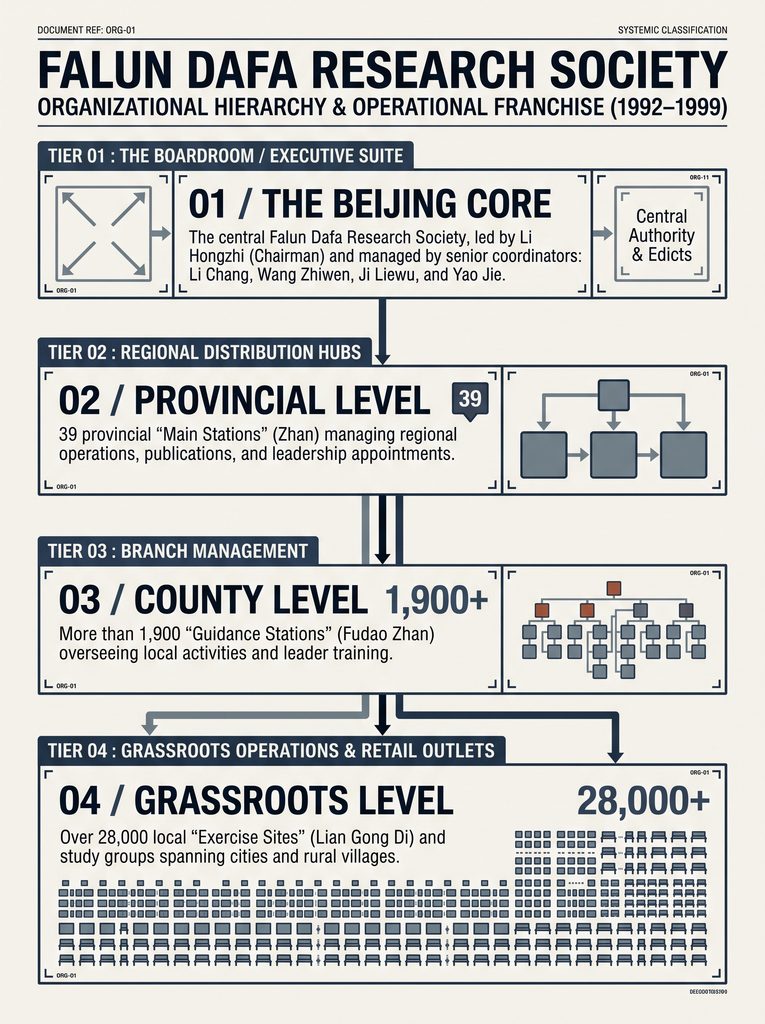
This central network managed nationwide book sales, published strict instructional guidelines, and coordinated over three hundred protests against media outlets between 1996 and 1999. Mobilising ten thousand followers outside Zhongnanhai on 25 April 1999 was not an uncoordinated miracle, but the result of a disciplined, well-managed administrative apparatus.
The April 25 Incident & The 44-Hour Beijing Flight Log
Defending the Official Line
For years, whenever journalists or researchers asked about the events that triggered the Chinese government’s crackdown in 1999, I delivered the official media response with practiced conviction. As Global Marketing Director, I repeated the rehearsed narrative: the gathering of ten thousand practitioners outside the Zhongnanhai government compound in Beijing on 25 April 1999 was an entirely spontaneous, grassroots appeal. Most importantly, we insisted that Master Li Hongzhi had no prior knowledge of the event, was nowhere near Beijing when it occurred, and was merely in transit through Hong Kong on his way to Australia.
We framed this story as a triumph of non-violent civic action that caught both the Chinese state and our own leadership by surprise. To question this timeline was treated within our offices as an attack on the movement itself.
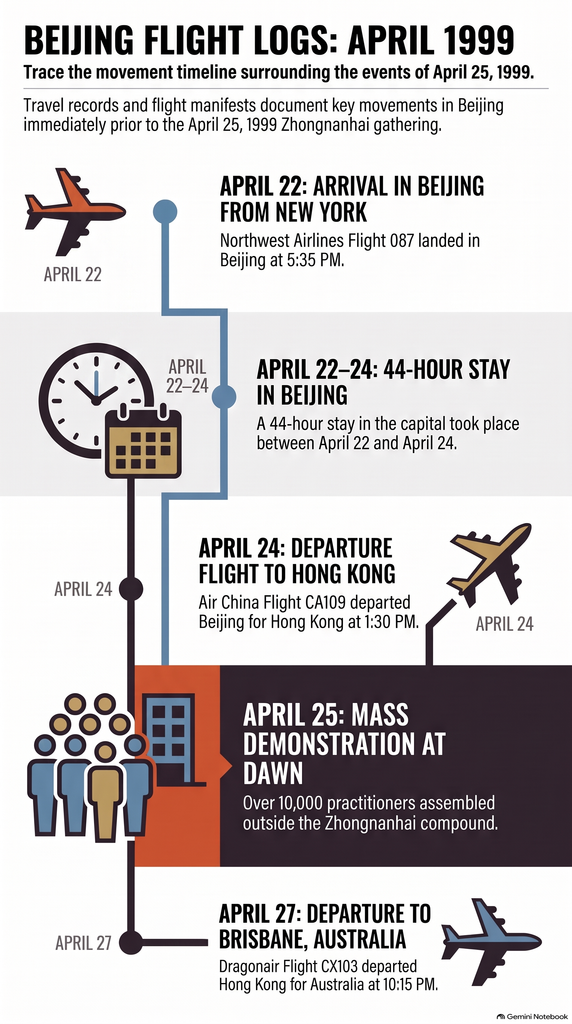
It was only years later, when I stepped back from the organisation and examined official border control registries, airline manifests, and internal communications, that the narrative collapsed. The physical evidence revealed that Li Hongzhi had not been thousands of miles away. He had arrived in Beijing just hours before the mobilisation began, stayed for nearly two days, and departed less than twenty-four hours before ten thousand of his followers surrounded the central headquarters of the Chinese government.
The Anatomy of the Zhongnanhai Incident
To understand the significance of the 25 April demonstration, one must examine the chain of events that preceded it. In mid-April 1999, physicist He Zuoxiu published an article in Tianjin Normal University’s Youth Reader magazine criticizing Qigong practices and highlighting health risks associated with Falun Gong. Local practitioners organized sit-ins outside the magazine’s offices. Between 23 and 24 April, Tianjin riot police intervened, arresting forty-five practitioners.
Local coordinators informed the Tianjin gathering that higher authorization would be required to resolve the issue, pointing practitioners toward the central appeals bureau in Beijing. Overnight, the administrative apparatus of the Falun Dafa Research Society mobilized across multiple provinces. By dawn on Sunday, 25 April, more than ten thousand practitioners had quietly assembled in silent rows around the perimeter of Zhongnanhai, the walled compound housing China’s top leadership.
Premier Zhu Rongji met with practitioner representatives, agreed to listen to their grievances regarding the Tianjin arrests and publishing bans, and promised a peaceful resolution. The crowd dispersed quietly that evening. However, Communist Party General Secretary Jiang Zemin viewed the demonstration as a direct challenge to state authority, writing a private letter to the Politburo that midnight warning that the group’s organisational strength threatened the party. Three months later, on 22 July 1999, the state formally banned Falun Gong, launching a nationwide suppression campaign.
Deconstructing the Four Critical Deceptions
When Chinese authorities released immigration logs in May 1999 proving that Li Hongzhi had entered Beijing on 22 April, the movement was forced to adjust its public narrative. Examining these shifting explanations reveals four fundamental deceptions that lie at the heart of the movement’s leadership structure.
1. The Moral Contradiction with Truthfulness (Zhen)
When first interviewed by Australian and international journalists in early May 1999, Li explicitly denied having been in Beijing, asserting he was continuously in transit to Australia. Once border control logs and flight manifests were published, he amended his account, acknowledging his presence in Beijing but claiming he was merely changing flights and remained secluded in a private residence for forty-four hours without speaking to anyone or learning about the gathering.
For an organisation that demands absolute adherence to Zhen (Truthfulness) from its members, the founder’s shift from total public denial to a legalistic claim of secluded transit created a glaring moral contradiction.
2. The Theological Omniscience Paradox
Within Falun Gong doctrine, Li Hongzhi is depicted as an omniscient master who possesses millions of spiritual bodies (fashen) capable of observing every thought and action of his followers worldwide.
Claiming that he sat in a Beijing apartment for forty-four hours entirely unaware that ten thousand of his core disciples were actively organizing a massive political demonstration creates an insoluble logical trap. Either he possessed full operational knowledge and oversaw the event, making his public denials false, or he was genuinely oblivious to the largest mass gathering in Beijing since 1989, completely dismantling his claim of divine omniscience.
3. Plausible Deniability and Leadership Failure
Academic analyses of the incident emphasize that while ordinary practitioners joined the gathering out of sincere faith, central coordinators in Beijing managed the complex logistics. By insisting on his complete personal seclusion and non-involvement, Li established a layer of plausible deniability for himself overseas.
When the state crackdown began, senior Beijing coordinators including Li Chang and Wang Zhiwen were arrested and sentenced to prison terms of up to eighteen years. The leader remained safely insulated in North America, while those who executed his organizational directives spent decades in Chinese penitentiaries.
4. The Institutional Cover-Up
To preserve the narrative of a peaceful, surprise gathering overseen by an uninvolved spiritual leader, the movement engaged in systematic archival sanitisation. Early press releases, transcript excerpts, and forum discussions from May 1999 that contained contradictory statements about the trip were retroactively edited or purged from the official Minghui website. This ongoing rewriting of internal history ensures that newer western converts remain unaware of the documented flight manifests and early media denials.
Apocalyptic Mathematics & The Tuidang Campaign
The View from the Marketing Desk
In late 2004, The Epoch Times launched the Nine Commentaries on the Communist Party, a series of editorials that would fundamentally reshape the newspaper’s mission and the movement’s global strategy. Shortly after its publication, the organisation established the Tuidang (Quit the Party) Service Centre, launching a global campaign urging Chinese citizens to publicly renounce their ties to the Chinese Communist Party (CCP), the Communist Youth League, and the Young Pioneers.
As Global Marketing Director, my job revolved around data, reach, and conversion metrics. Every day when I logged into our media systems, the live Tuidang counter sat prominently on our web platforms, ticking upward continuously. In newsroom meetings and marketing sessions, we celebrated each milestone: ten million, fifty million, one hundred million resignations.
Yet for anyone working closely with data, a quiet, persistent panic set in. As a marketing professional, I knew how audience metrics worked, and the numbers displayed on our counter rapidly diverged from basic arithmetic. We were asserting that hundreds of millions of Chinese citizens were risking severe state retaliation to log onto western-hosted servers and quit an organisation whose total historical membership was a fraction of that figure.
When I raised quiet questions about verification procedures or how web traffic was being audited, the response was swift and ideological. In the worldview of the movement, the Tuidang movement was not a secular political campaign; it was a cosmic process of spiritual cleansing ordained by Master Li. To question the numbers was framed as a lack of faith, a manifestation of human notions that threatened the monumental effort to save sentient beings.
Pre-1999 Membership Claims versus Academic Estimates
The pattern of statistical inflation did not begin with the Tuidang campaign. It has been a core element of Falun Gong’s public relations strategy since the mid-1990s.
Before the 1999 government ban, movement press releases and media statements routinely claimed that Falun Gong had between 70 million and 100 million practitioners in mainland China, occasionally asserting that adherents outnumbered the Chinese Communist Party itself. This dramatic figure was widely repeated by western media outlets eager for a David-versus-Goliath narrative.
When sociologists and academic researchers examined the movement’s actual footprint, however, the numbers told a very different story. Detailed field studies and organizational analyses by scholars such as Dr David Ownby and Dr James Tong examined exercise site density, book sales, and local guidance station registries. They estimated that active pre-1999 membership in China was actually closer to 10 million practitioners.
Exaggerating membership figures served dual interests at the time. For the Chinese state security apparatus, inflating the group’s size provided a convenient pretext to justify a massive, high-priority crackdown. For Falun Gong leadership, claiming 100 million adherents created an aura of overwhelming popular legitimacy and invincibility.
The Mathematics of the Tuidang Campaign
When the Tuidang campaign was introduced in 2004, this tendency toward numerical inflation reached unprecedented levels. The movement claimed that Chinese citizens were flocking to The Epoch Times website to submit formal statements renouncing their party affiliations.

By examining official political and demographic statistics from China, the mathematical impossibility of these claims becomes immediately apparent:
- Actual Party Membership Limits: Official CCP records show that total party membership grew from roughly 70 million in 2004 to approximately 98 million members today.
- The Resignation Discrepancy: The Tuidang platform currently claims over 400 million cumulative resignations. Even if every single living member of the CCP had resigned, the claimed total would still exceed total actual party membership by more than 400 percent.
- Youth Affiliate Conflation: To account for this vast gap, movement spokespersons argue that the figures include resignations from the Communist Youth League and the Young Pioneers, organizations that almost all Chinese primary and secondary students join automatically during childhood. However, membership in these youth organizations automatically expires upon reaching adulthood, rendering formal “renunciations” in adulthood politically redundant.
How the Numbers Are Generated and Why Believers Accept Them
Independent digital audits, computer science researchers, and former movement IT volunteers have explained the technical mechanics behind these ballooning statistics:
- Proxy and Alias Submissions: The Tuidang website explicitly allows practitioners living outside China to submit “resignations” on behalf of relatives, friends, or deceased ancestors residing in mainland China.
- Symbolic Pseudonyms: Submissions do not require verified legal identity. A single individual can enter dozens of symbolic aliases in a single session, using names like “Clear Mind”, “Future Hope”, or “Auspicious Dawn”.
- Automated Counters and Scripts: Digital analysts examining the platform noted the use of automated submission scripts and unverified web counters that increment automatically to maintain public momentum.
Why do devoted practitioners defend these numbers without hesitation? Within Falun Gong theology, renouncing the party is not viewed as a political act, but as a mandatory spiritual requirement. Master Li taught that the CCP is inhabited by an evil “red dragon” spirit, and that anyone who ever raised their hand in a childhood school pledge carries the “mark of the beast.” According to internal doctrine, those who fail to renounce their ties will be destroyed alongside the party during the imminent cosmic purification.
For a true believer, generating lists of pseudonyms and submitting them to the server is viewed as a compassionate act of cosmic rescue. The validity of the data is secondary; the primary goal is fulfilling a spiritual mandate. In this environment, mathematical accuracy is sacrificed to maintain an apocalyptic narrative designed to impress western political observers and maintain high-pressure urgency among followers.
The Human Balance Sheet & Medical Avoidance
The Ultimate Sacrifice
Of all the doctrines I defended during my time in Falun Gong, none carried a heavier personal toll than the movement’s stance on modern medicine. It is one thing to argue over flight manifests or debate statistical models in an office. It is an entirely different nightmare to sit at the bedside of someone you love and watch them endure excruciating, preventable physical suffering because they believe that seeking medical care will forfeit their eternal soul.
I watched this tragic dynamic unfold within my own family. When treatable physical conditions emerged, the response was not to consult a doctor or go to a hospital. Instead, the illness was interpreted through the strict lens of Master Li’s teachings: physical disease is not a biological event, but the manifestation of karmic debt accumulated from past wrongdoings. To seek medical treatment, we were taught, was to take poisonous pills that merely pressed karmic impurities deeper into the body, ruining one’s spiritual purification and failing the ultimate test of faith.
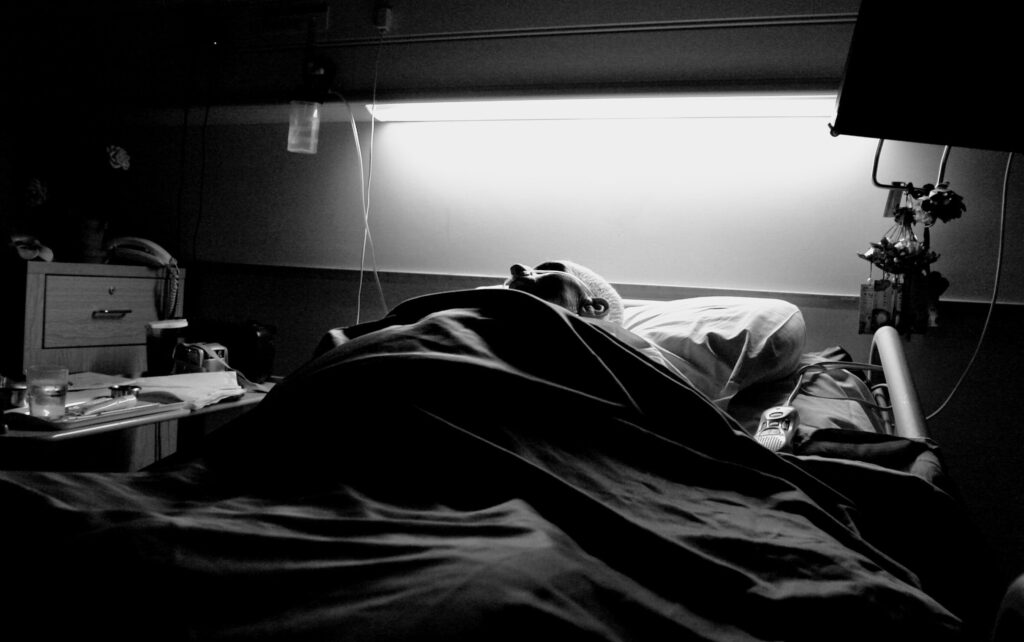
Watching my parents decline in pain while holding out hope for divine cleansing was devastating. It was a silent, agonising ordeal repeated in thousands of households worldwide. In our public media suites, we assured western journalists that seeking medical care was purely a matter of personal choice. But in the quiet privacy of our homes, devoted believers suffered and died in silence, convinced that accepting a prescription or undergoing surgery would strip away their status as true cultivators and destroy their chance at cosmic salvation.
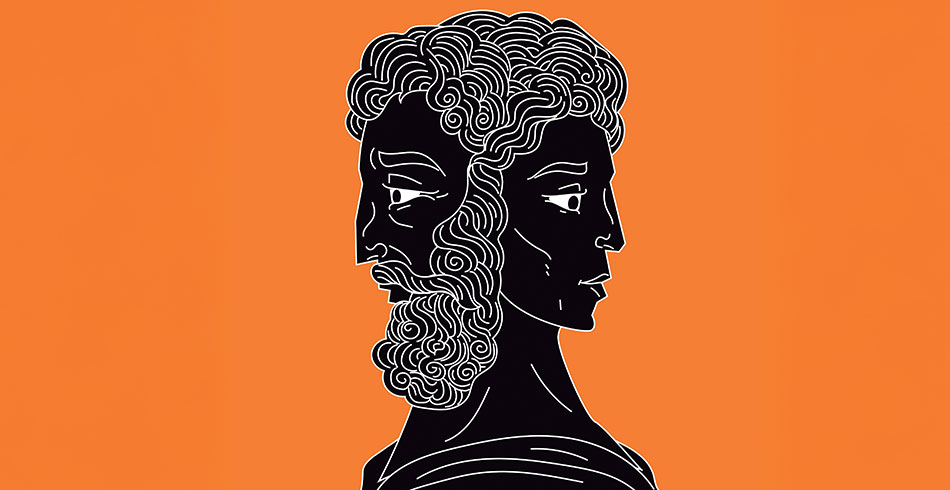
The Janus-Faced Doctrine of Medical Avoidance
When external media outlets or public health inquiries question Falun Gong representatives about members dying from untreated medical conditions, movement spokespersons consistently maintain that the practice has no prohibition against medical care. They argue that Falun Dafa has no rules, that attendance at hospitals is an individual decision, and that any member who refuses treatment does so entirely of their own volition.
However, a direct examination of Li Hongzhi’s core scriptures, particularly Zhuan Falun and his collected lecture series, reveals a starkly different reality. The internal doctrine establishes an absolute theological barrier against modern medicine:
- The Origin of Illness: Li explicitly teaches that human disease is fundamentally caused by karma (yeli) generated by wrongdoings in past lives. Biological pathogens and cellular breakdowns are framed merely as surface manifestations of spiritual debt.
- The “Poisonous Pill” Concept: In his lectures, Li asserts that hospital treatments, pharmaceutical drugs, and surgical procedures cannot eliminate karma. Instead, he teaches that medication simply pushes karmic debt back inside the body, where it accumulates until it manifests as a more severe, fatal illness later.
- The Cultivation Test: When a practitioner falls ill, the condition is defined as “sickness karma” (bingye), a necessary spiritual test designed to purify the body. Taking medication or visiting a physician signals to the cosmos that the individual does not truly trust the Master’s divine power, immediately reducing them to the status of an ordinary person who can no longer achieve Consummation.
This dual structure is a classic manifestation of the movement’s Janus face. The external PR statement (“it is an individual choice”) provides legal and public insulation, while the internal scripture (“medicine ruins your purification”) creates an intense psychological prohibition that deters devoted followers from seeking life-saving care.
Evaluating Mortality Claims and the Human Balance Sheet
Understanding the human cost of Falun Gong requires navigating two fiercely competing bodies of propaganda: the claims of the Chinese state security apparatus and the counter-claims of the movement’s human rights organizations.
Following the July 1999 ban, Chinese state media launched an aggressive campaign asserting that over 1,400 practitioners had died between 1992 and 1999 as a direct result of refusing medical treatment or committing suicide under the influence of group doctrines. Independent researchers and sociologists point out major methodological flaws in these state figures. The Chinese government compiled unverified police logs and public health registries without external oversight, sweeping natural deaths within a massive, elderly practitioner cohort into a single politically charged total to justify its crackdown.
Conversely, Falun Gong human rights documentation centers have recorded thousands of verified deaths of practitioners inside China since 1999. These accounts detail severe physical abuse, systemic torture, forced labor, and deliberate medical neglect within state detention facilities and labor camps.
The tragedy of this conflict lies in its double-edged nature. On one side, thousands of innocent believers inside China have suffered brutal state repression, arbitrary detention, and violent abuse simply for holding fast to their spiritual convictions. On the other side, outside the prison walls, countless devoted adherents have quietly surrendered their lives to treatable illnesses, sacrificed on the altar of a dogma that brands modern medicine as a spiritual failure.
For those of us who survived the movement and lost loved ones to this ideology, acknowledging both realities is essential. We can unequivocally condemn state violence and human rights abuses while simultaneously exposing the lethal internal doctrines that lead sincere, loving people to refuse the medical care that could have saved their lives.
Reclaiming Truth and Personal Sovereignty
The Somatic Fallout and the Physical Price
When you spend over a decade inside a high-control system, walking away is rarely a simple, clean break. You do not merely resign from an office or close a laptop. You sever a totalising reality that dictated what you ate, how you worked, what you thought, and how you understood your place in the universe.
When I finally stepped out of the movement’s orbit, the psychological release was almost immediately shadowed by a severe physical collapse. Years of unrelenting work hours, chronic sleep deprivation, suppressed grief, and the constant, subconscious hyper-vigilance of living under the gaze of an omniscient master took their toll. My body simply gave out.
In the months and years that followed, I was diagnosed with a cascade of chronic conditions, including LADA diabetes, ME/CFS, and the constant, debilitating joint and muscle pain of Fibromyalgia. When I consulted medical specialists, they pointed to a clear underlying trigger: my nervous system was paying the somatic bill for years of unaddressed trauma. The body was keeping the score.
The hardest part of recovery was not the physical pain, but de-programming the deep psychological fear installed by the movement. For years, practitioners are taught that anyone who leaves, speaks out, or critiques Master Li will suffer immediate cosmic retribution, physical destruction, or eternal damnation. Learning to breathe through a pain flare-up without believing it was a divine curse required unlearning a decade of mental conditioning.
Breaking the Silence: Decult and Self-Sovereignty
Healing began when I stopped running from the past and started looking directly at the evidence. I realized that the only way to neutralize the fear was to examine the facts with uncompromising intellectual honesty. The flight logs, the altered identity cards, the inflated statistics, and the medical doctrines were not spiritual mysteries; they were historical realities that could be analysed, understood, and dismantled.
Moving to Christchurch and building a life grounded in the physical world became my sanctuary. I founded an eco-cleaning business, Smell Hound, focusing on tangible, honest work that reconnected me to everyday community life. For the first time in my adult life, my time and energy belonged entirely to me.

I also joined Decult, a New Zealand organisation dedicated to cult awareness and survivor support. Co-facilitating support groups for individuals exiting various high-control groups revealed a profound truth: whether a group claims to be a Christian commune, a commercial self-help movement, a political sect, or an eastern spiritual practice, the mechanics of high-control systems are remarkably identical. They all rely on manufactured authority, isolated information loops, guilt-driven labor, and the systematic suppression of critical thought.
Conclusion: Facing the Record to Honour the Past
Writing this investigation and laying out these documented records is not born out of malice, bitterness, or a desire for revenge. It is driven by a fundamental commitment to truth and human dignity.
For years, I helped construct a media narrative that asked the public to accept a manufactured version of history. To remain silent now, when documentary evidence clearly disproves those foundational claims, would be a betrayal of the very principle of Truthfulness (Zhen) that drew me to the practice in the first place.
Exposing the 44-hour Beijing flight timeline, the 1994 identity alteration, the mathematical impossibility of the Tuidang totals, and the tragic consequences of medical avoidance does not diminish the genuine suffering of practitioners inside China. Thousands of innocent people have faced horrific state persecution, and their human rights must be defended without hesitation. But defending human rights does not require protecting a high-control system from historical scrutiny.
To my former colleagues, to current practitioners, and to anyone navigating the long road out of a high-control group: facing these facts is not a sin. Questioning a leader who altered his own birthdate to match a deity is not a spiritual failing. It is the first, essential step toward reclaiming your mind, your health, and your personal sovereignty.
Truth does not fear evidence. Real freedom begins the moment you dare to look.
Want to read more about the mechanics of coercive control?
My forthcoming memoir, Saving Sentient Beings: A Global Career in Cult Propaganda, offers an unflinching, insider account of fourteen years spent inside the media and propaganda apparatus of Falun Gong. To receive exclusive early previews of upcoming chapters, archival documents, and essays on post-cult recovery, join the launch list here.