The Inheritance of the Unusual
It was the final straw the day my father, Robert George Gibson, passed away in the red brick compound of St Mary’s Hospice right on the border between Bethnal Green and Hackney. I no longer believed in Falun Gong and wanted to leave. In cult parlance, I was PIMO: physically in, mentally out.
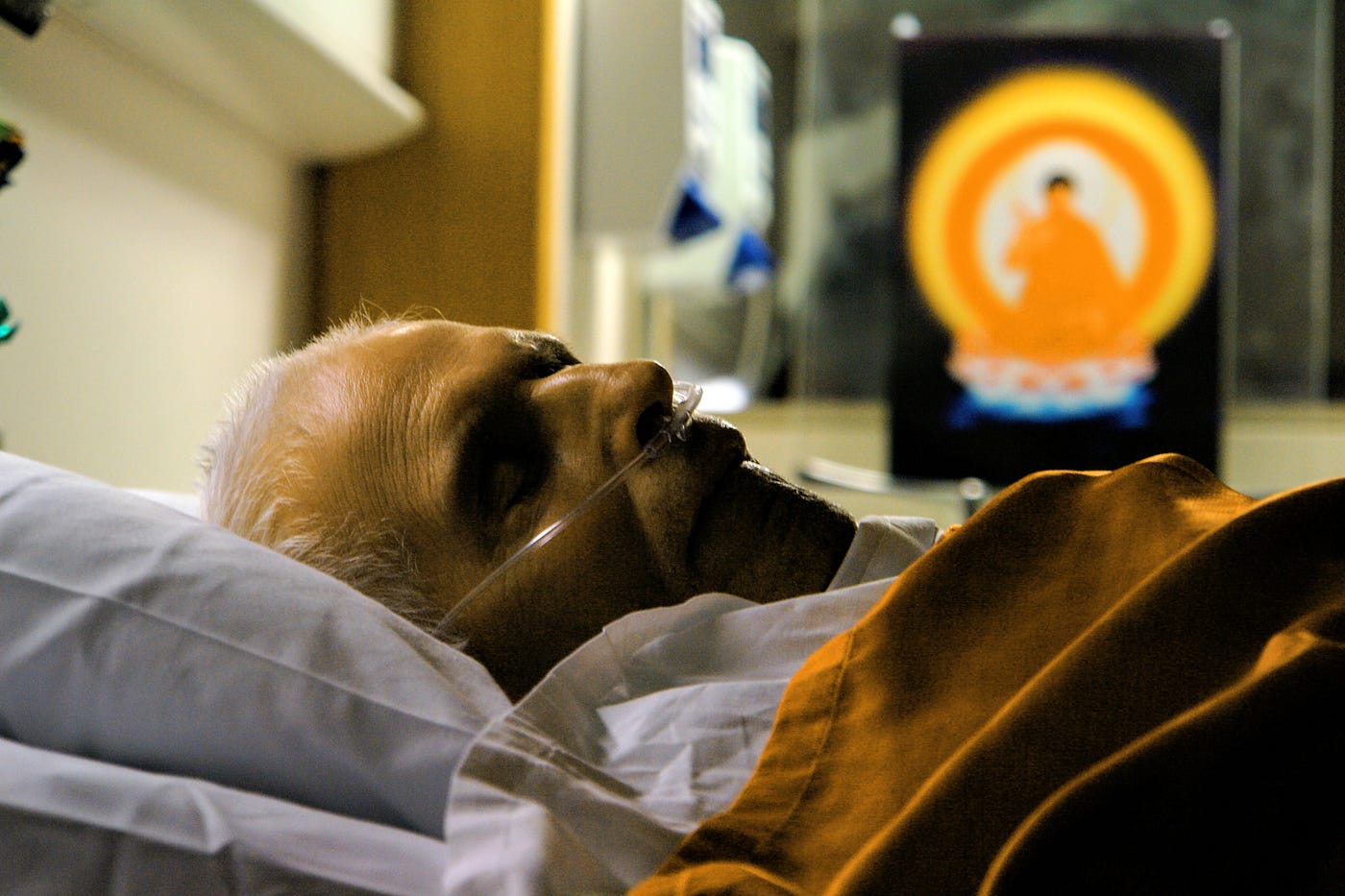
Robert Gibson lying underneath a portrait of Falun Gong cult leader Li Hongzhi. St Mary’s Hospice, London, 20th September 2008
Watching him slowly die of pancreatic cancer while actively refusing any real medical intervention because of his steadfast belief in Falun Gong was the most emotionally and spiritually agonising experience of my forty-odd years on this floating rock. He did not look like a martyr: he looked like an ancient, anorexic Homer Simpson. His skin was a wrinkled, jaundiced yellow, draped over a frail skeletal frame, punctuated by an abnormally extended, bloated belly that looked ready to burst. It was grotesque. I am a physically affectionate guy by nature, but I could not even bring myself to touch him. I felt a nauseating cocktail of disgust, furious anger, and a crushing sadness. This was the reward for his unyielding dedication to Li Hongzhi, the supposed Creator of the Universe: dying in agony while claiming his rotting organs were just being purified.
My father did not view his slow motion suicide that way. He saw it as his final test, a celestial exam he had to pass to achieve enlightenment and move onto the next realm. I just wanted to scream at him that it was all absolute bullshit and he did not need to put himself and everyone else through this. But the last thing I wanted to do was to strip away his faith in his final hours. That would only add to his pain, not diminish it, and end up being even more cruel than the cult itself.
The Breeding Ground: Sherborne House
I had been slowly collecting doubts about the practice from the very beginning. Every doubt that entered my mind was like putting a rock in my backpack whilst trying to ignore the ever increasing weight over time. Eventually, all the doubts began to drag me down more and more until I could no longer move. I was so desperate for spiritual success that I let all of the red flags pass me by until my own mortality was staring me in the face in the form of my dying father.
It was the final, deepest cut, the one that broke the last splinter of my faith. The UK practitioners’ reaction was pure, clinical horror: a cold judgment that it was “his karma” and he wasn’t a “good practitioner”. I was actually scolded for being upset, as a true practitioner, apparently, remains an unfeeling stone. That moment, when they deemed grief a spiritual failure, was the only clear direction I ever received: get out. With every unanswered question and every unfulfilled prophecy, the relief I felt when I finally walked out of that suffocating, fantasy bubble was the first genuine feeling I’d had in years.
When I was born in 1975, my parents were living in the commune of the Fourth Way cult housed in Sherborne House, a Downton Abbey-esque Grade II listed stately home. The cult was based upon the teachings of G.I. Gurdjieff, an Armenian philosopher who created the movement at the beginning of the 20th century. This commune was formed under the moniker “International Academy of Continuous Education” (IACE) by one of Gurdjieff’s students, John Godolphin Bennett, a British academic and writer. The students, like my parents, were mostly wealthy upper middle class academics who wanted to live a counterculture lifestyle with more spiritual depth than most traditional religions were offering at the time. My mother had never worked a normal job due to her inheritance and dad quit his teaching career after attending the first Glastonbury festival, never to work for anyone else again.
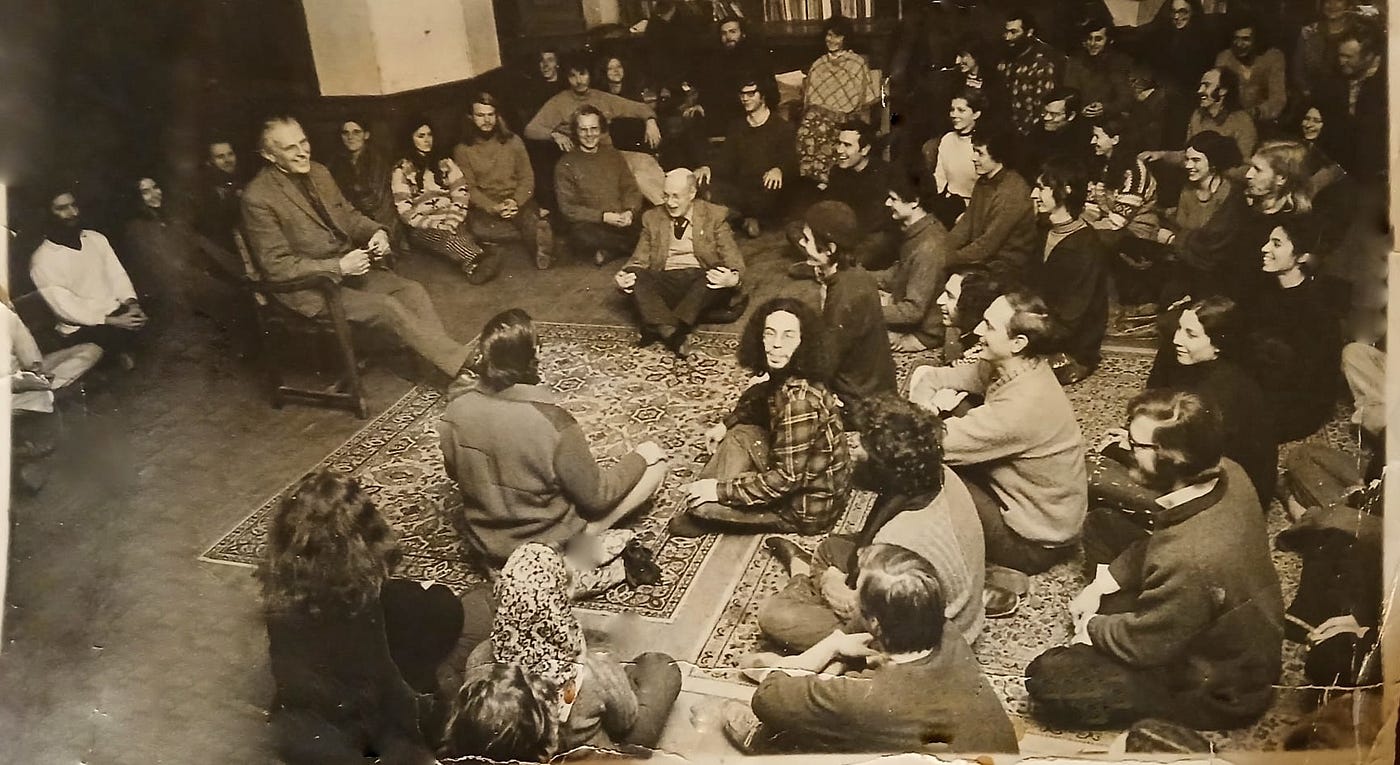
JG Bennett surrounded by his students, Sherborne, circa 1972
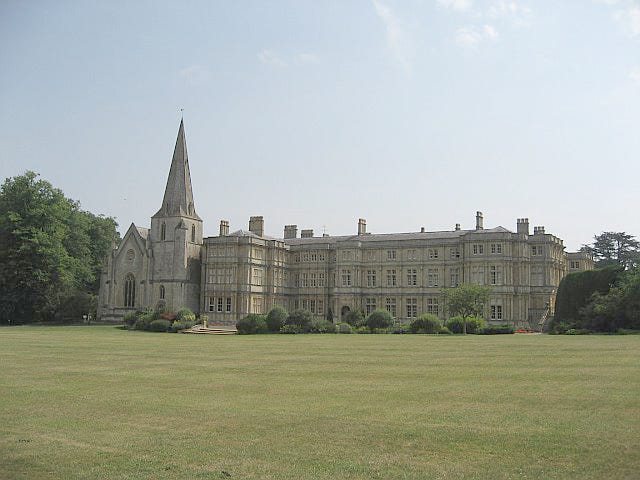
Sherborne House, Cotswolds, home of the IACE (Fourth Way Cult)
The American Experiment and Abandonment
After Bennett passed away in 1974, the group moved to the US the following year and created a community in West Virginia called The Claymont Society which still exists today. That same year, my parents bought a farm in the remote Scottish highlands alongside other members who didn’t want to move to the USA. We lived in a small community of neighbouring farms, all owned by IACE students, for a decade before they eventually sold up and followed the cult to the US.
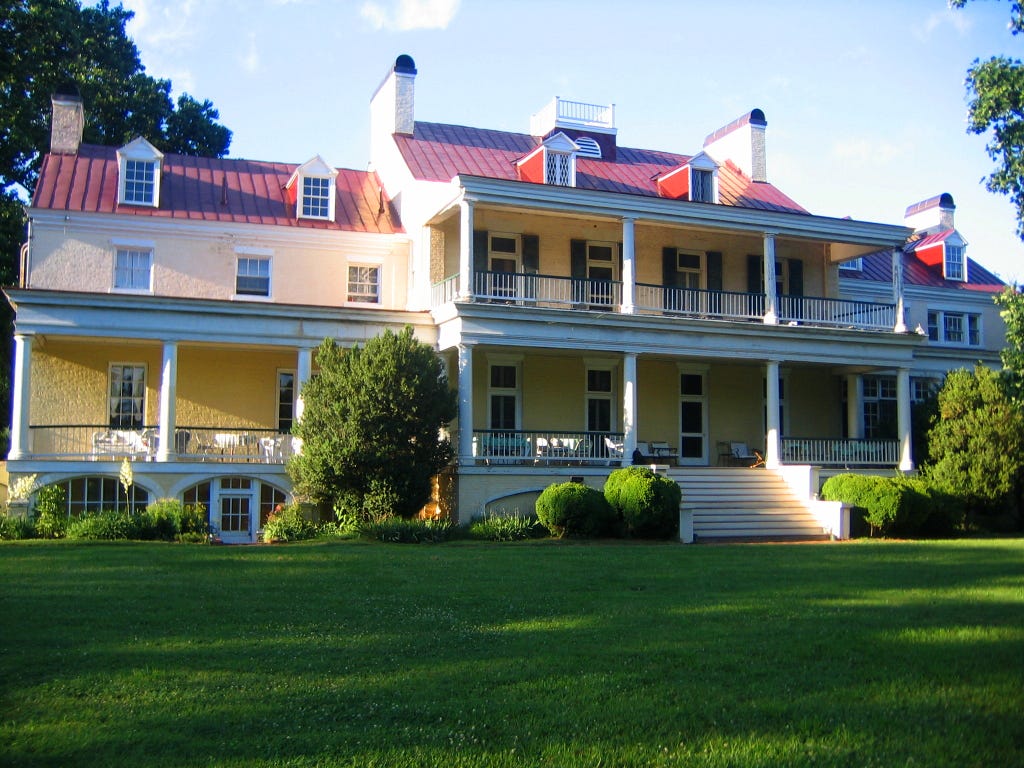
The Claymont mansion (residence and practice area) at Claymont Society, West Virginia.
Just outside of Charleston, West Virginia, and a stone’s throw from Harpers Ferry, I was left alone to live with a family I didn’t know and attended the cult’s school at Claymont Society. The family was nice enough, but I felt abandoned and left completely out of the loop. I had no idea why any of this was happening. This allowed my parents to go off exploring various other sects and cults, including Osho, in which they had friends who were arrested with weapons in the back of their car. They attended courses at countercultural organisations such as the controversial Esalen Institute in Big Sur, California, and The Robert Monroe Institute for expanded consciousness in Virginia. After a couple of years, my parents decided that they were not on the right path to enlightenment. Disillusioned with the lack of progress in the cult’s mission, they lost interest. My father showed no interest in staying, even after being asked to become the new leader. He was a stoic man who resisted anything that could corrupt his ego. I was 12 years old and my parents wanted me to join a primary school so I would have friends going into high school. So we moved back to Scotland.
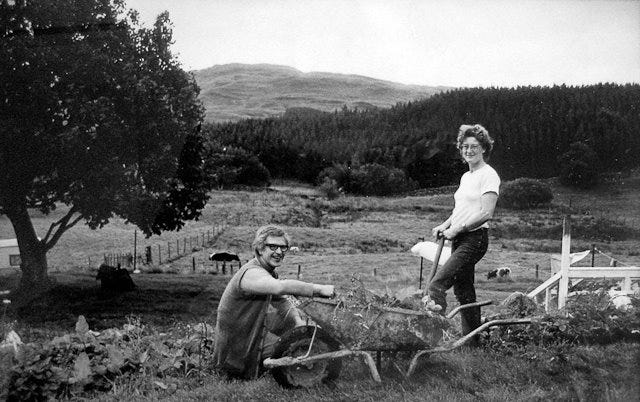
Robert and Penelope Gibson gardening at the farm Tomocrocher.
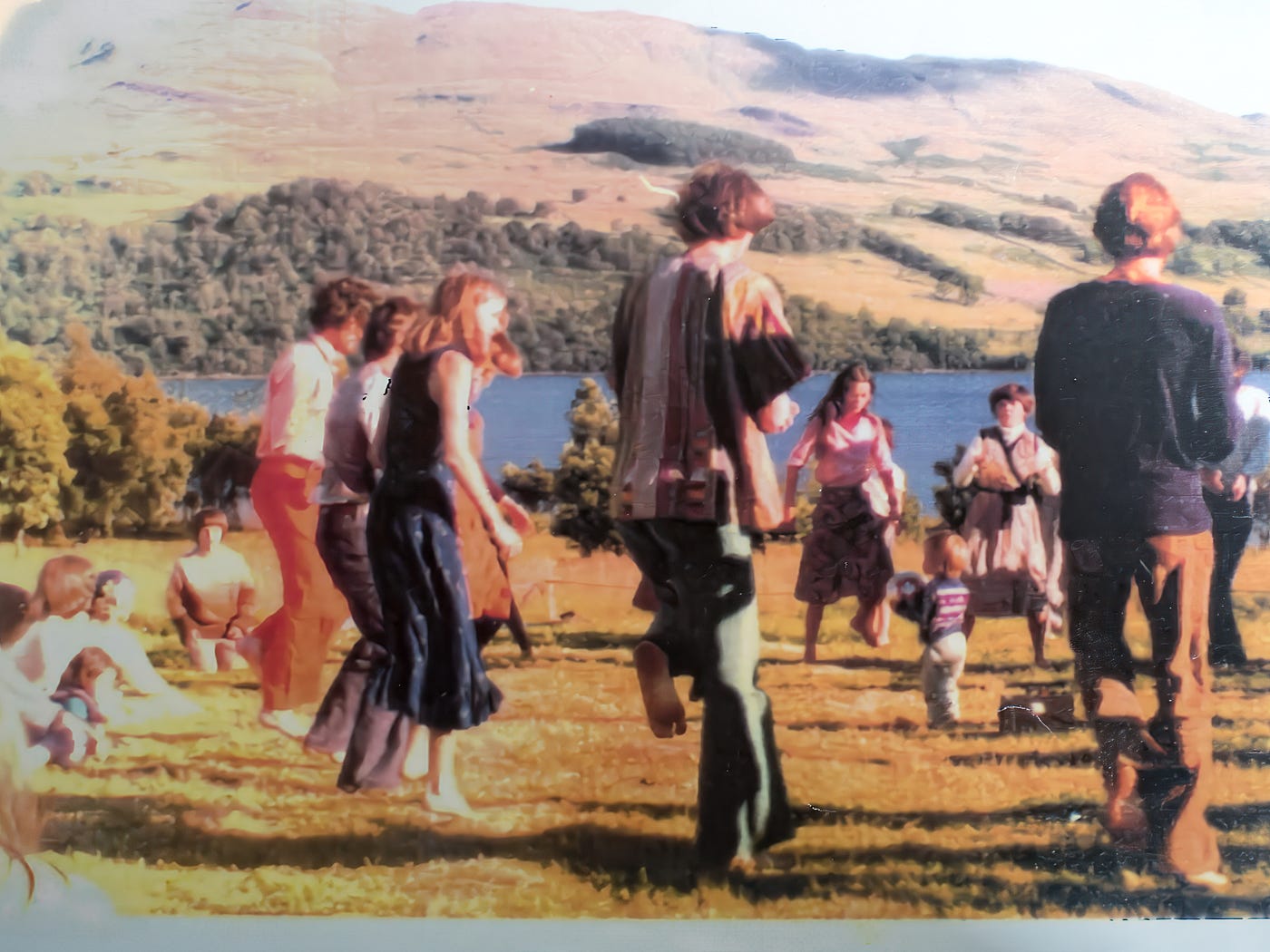
Me in the middle of a “dance circle”, Tomocrocher, Scotland, 1977.
The Heroin Interlude: India
My parents called themselves “seekers of the truth”. They devoured books on metaphysics, philosophy, quantum mechanics, and astral projection. They were the real deal. As it was, I grew up in this heady environment where spiritual debate was openly practised and being open to new things was a way of life. This was the context I grew up in. I admired my parents, I felt loved, and I believed them to be good people: and they were, if a little naive. I became a seeker too. After we had left the Fourth Way behind, I developed my own spiritual interests. I even tried Christianity as a teenager but was soon appalled at the hypocrisy of people’s actions compared to what they preached. An unwelcome feeling that would soon become familiar.
When I was 17, my parents sent me to India because I had fallen in with a bad crowd and started using heroin. I went to a notoriously rough school at the time, Bell Baxter High in Cupar, Fife. Three of my school friends died that year because of drug abuse. Mum and dad were worried I was going down a road I couldn’t return from and off I was sent to live with my brother in Vadodara, Gujarat. For the best part of a year, I travelled on my own getting into all sorts of trouble. Eventually, I found a traditional Rajasthani art school that would accept me as a student and settled in Udaipur, Rajasthan. For the rest of my stay, I studied Rajasthani miniature painting and decided on my return to go to art school in London.
The London Carousel: Scientology and the FWBO
Living in London was the beginning of my personal spiritual journey. Whilst at art school, I stumbled across a cult that my brother had been involved with some five years prior called Friends of the Western Buddhist Order. This was an insidious cult that was exclusively for men. It promoted homosexuality as a spiritually superior form of sex because there was no attachment to family. When I heard that, I thought, that’s weird. I know plenty of gay men in meaningful relationships that would require reciprocal attachment or emotional affection. Ultimately, I found that idea weak and strange, as I knew many men that genuinely loved other men without it being about sex or otherwise. Nonetheless, it wasn’t for me.
In December 1999, I was accosted by a Scientologist on Tottenham Court Road with a personality test. My narcissistic side got the better of me and off I went down the rabbit hole for six months. I asked dad to join me. He reluctantly took the personality test. He did not like the results and declared the whole thing was a load of crap. Having thought I had found “the path” and wanting to impress dad, I was absolutely devastated. I valued his opinion highly, so when he rejected it, I rejected it too. The Scientologists would call me every week, harassing me to come in for more “audits”. I was only able to escape their clutches because I broke up with my girlfriend and moved to New Zealand the following year.
The Rock Softens
After a year in New Zealand, I was still looking for my thing. My purpose. I went back to London to catch up with friends and family, only to find my father, had given up alcohol and smoking because he had started a new practice called Falun Gong. These were two things I never thought I would see him willingly part with. It was impressive because my siblings and I had been pestering him to give up cigarettes for years. We affectionately called him “The Rock” because he was impenetrable and immovable. Did I mention he was hard to deal with? Anyway, I was naturally intrigued and joined in.
Initially, I was interested in the health side of things. The thought of doing some gentle exercise and meditation in a group outside in a park, for free, appealed to me. It was benign at first. There were no priests, hierarchy, temples, uniforms, rhetoric, or dogma: all things I detest. When I actively started practising, or “cultivating,” in 1998, it was just a peaceful qigong practice with no human rights or political agendas. It was simple and felt powerful due to the lack of spiritual baggage that so many practices and religions were based on. Also, it was falsely advertised as an ancient practice handed down from master to student and this was the first time it had been “allowed” to be taught publicly.
The Hook of Self-Loathing
I began to read the main text, Zhuan Falun, and was impressed by the audacious claims and the promise of my own paradise in the next realm. Dad had found the path. I was hooked. It is worth noting that at that time my self-esteem was very low and I really hated myself. I thought I was a piece-of-shit asshole who did not deserve to be loved. I had really struggled socially since leaving home and suffered from deep depression and chronic suicidality, all peppered with manic outbursts that were later diagnosed as Bipolar Type II. I wanted Falun Gong to help me become a better person. Enlightenment seemed so far off that I did not even give it a thought.
There were only a handful of Westerners practising in London at the time. We would gather at Peter Jauhal’s West End apartment to read the book together, share our understandings, and discuss the teachings and their application to our lives. Peter was the reluctant de facto coordinator of the UK because he and his wife, Jess, had brought the practice over from a trip to Europe. He was reluctant in that he had no interest in becoming any type of leader but felt obliged to carry out this so-called duty. Initially, Peter and Jess had been searching for an alternative healing method for Jess, who was suffering from a chronic illness similar to the fibromyalgia I would later be diagnosed with.
The Dawn of the Persecution
It was all very wholesome and I felt like a new dawn was rising in my life. Things are going to be different now, I thought. Things are going to be better. Dad and I are on the path. Then almost overnight everything changed.
On 25 April 1999, infamously known as “425,” ten thousand practitioners surrounded Zhongnanhai: the compound that houses the leadership of the Chinese Communist Party. It was framed as a spontaneous peaceful protest, but spoiler alert: it was not spontaneous. This infuriated the CCP leader Jiang Zemin, a hawkish throwback to a China most would prefer to forget. Zemin was so incensed at the gall of this display of soft power that he vowed to wipe out the practice in three months. Thus the persecution of Falun Gong began.
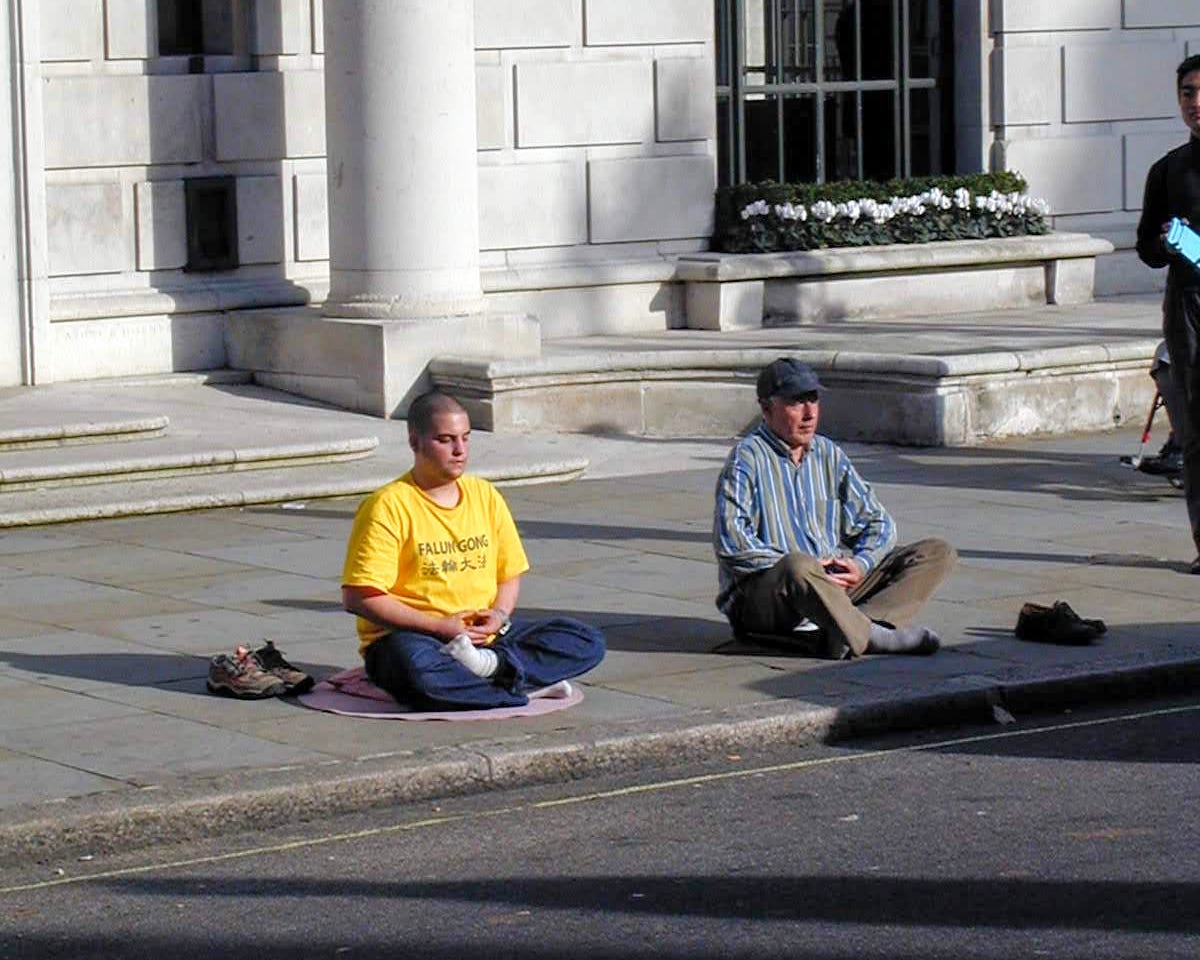
66 Portland Place, London, W1B 1AD. 4pm, Saturday the 30th September, 2000 AD.
I was always active in supporting human rights causes since I went to art college, but the crackdown in China felt personal. The persecution was brutal right from the outset with executions and incarceration without due process. Dad and I felt compelled to do something. Call it white saviour mentality, call it whatever you like, all we knew was that seemingly kind people were being tortured and we had to do something.
As a result, my dad and I became the first Falun Gong practitioners in the world to protest outside a Chinese Embassy. The location was 66 Portland Place, London, outside the Royal Institute of British Architects on the corner of Weymouth Street. It was Saturday, 30 September 2000, at 4:00 pm. The day had been full of blue skies and bright sunshine, balmy for that time of year at 16°C. We agreed to do the exercises and the meditation in the early evening to have the most impact on the rush hour traffic.
Gingerly, and visibly wincing, we sat down on the freezing cold yorkstone pavement and adopted our best attempt at the double-lotus position. It was pure torture. There is an odd microclimate in Portland Place because Weymouth Street aligns with the west-southwest wind. At that time of year, it blows in cold air from the Atlantic, and we were sitting cross-legged on freezing cold paving stones.
Much like the Fourth Way’s “intentional suffering,” it was exactly what we wanted at the time. Torture means experiencing pain, experiencing pain means transforming “karma,” and transforming karma means gaining “de.” The more “de” you gain, the greater your chances of “consummating” and going to heaven. So bring it on, freezing cold pavements and all, we were up for the punishment! Plus we were being good citizens and upholding human rights, which meant we also gained de for doing something good. What was to lose?
Soon everything changed and the practice evolved rapidly. All of the things I detested about religion started to creep in. Group-think took over. Bizarre things came up and I was so focused on the human rights aspect that I wilfully ignored the strange behaviours. I was desperate to become a better person and to improve my bad health, so I trudged on regardless.
The Paper Trail: London 2000
In 2000, during a brief stint in London, I was approached by a couple of Chinese practitioners who had heard I was a graphic designer. They were desperate to launch the first print edition of Da Jiu Yuan (DJY), the Chinese language Epoch Times, but they had no idea how to use desktop publishing software.
It was a bizarre, frustrating challenge. I created the layout templates and tried to teach them the software despite their limited English and my total inability to speak or read Chinese. It was a classic “blind leading the blind” scenario. After several sessions, they finally took the reins. I walked away thinking nothing of it, with no clue that I had just helped build the foundation of my own future prison.
Fast forward to April 2004. I was in Japan on business when David Jerke and Jared Pearman contacted me. They were in New York for a Falun Gong conference and wanted to discuss setting up an English print version of English Epoch Times. They wanted me as Marketing Director. Impulsively, I slammed a trans-pacific flight on my Amex and jetted from Tokyo to New York, lured by the promise of a project that might “change the world.”
We gathered in a cramped brownstone apartment in Queens. For three days, we hotboxed that small room, arguing over brand values, advertising, and content. From the start, I was against a newspaper. I pointed out that print was dying, that we lacked the capital, and that it would take a decade to break even. I advocated for a high-end magazine focused on China, something for Western thought leaders. A subscription model would look professional: not like a badly designed handout.
Li Hongzhi disagreed with me outright and said that it “had to be a mainstream newspaper” although this was communicated not in person but through intermediaries as he didn’t speak English. Later on, around 2008 his ambition became to replace the New York Times. I was gobsmacked. I pointed out that the NYT spent $70 million a year on journalism alone: we were hopelessly out of our depth. The word “mainstream” made me cringe because we were anything but. Our agenda was obvious, so why not own it? I was briefly shunned for my lack of “righteous thoughts,” and eventually, I told them good luck and flew back to New Zealand.
Back in NZ, my fashion brand, Gifted, was actually doing well. David and Jared followed me to Queenstown, and we all lived together in the “Gifted whare” on Queenstown Hill. It was a fun year until it wasn’t. Our bookkeeper embezzled money to feed a meth habit, a supplier broke his neck falling down stairs, and our main investor had a heart attack. The business folded, my visa expired, and I was left in massive debt.
I “respawned” in London like a player who had just lost a life in a video game. I was humiliated. I spent six months working for my old employers, KeeScott Associates, a second-tier creative agency that staggered about the industry like a lovable drunk. I sold my house and all my possessions at a heavy discount just to pay off debts and get back to New Zealand. There was a weird freedom in letting go of everything: an opportunity for a new adventure that turned out to be another trap.
The Singapore Incident: August 2006
The peak of the madness arrived in August 2006: what I now call the “Singapore Incident”. I was back in Melbourne on another expiring visa, sleeping on couches. One night, I attended a local Falun Gong study group in a suburban community room. It was raining, and the room was dimly lit and gloomy. The air felt thick, heavy, and nauseating. The usual housekeeping and “righteous thoughts” were performed, but the atmosphere was different. It felt like a funeral for a life I hadn’t quite finished living yet.The talk at the group was about some practitioners in Singapore who were being prosecuted for “protesting outside the Chinese Embassy and embarrassing them”. A wealthy practitioner at the group said she would pay for a trip for me to go there and expose what was happening. OK I guess this is what I am doing next I thought.
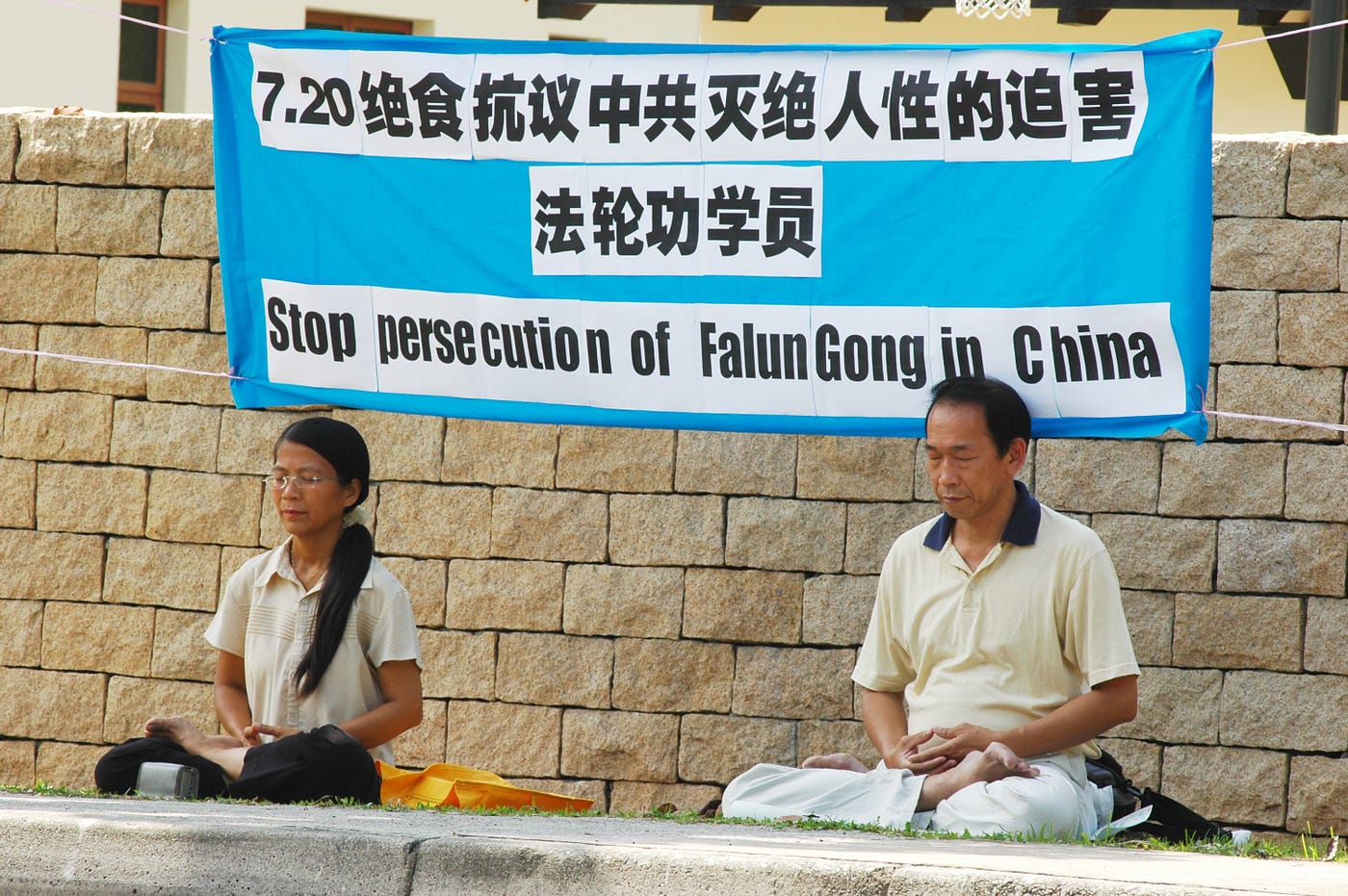
The two Falun Gong practitioners charged with embarrassing the Chinese Embassy in Singapore. 2006
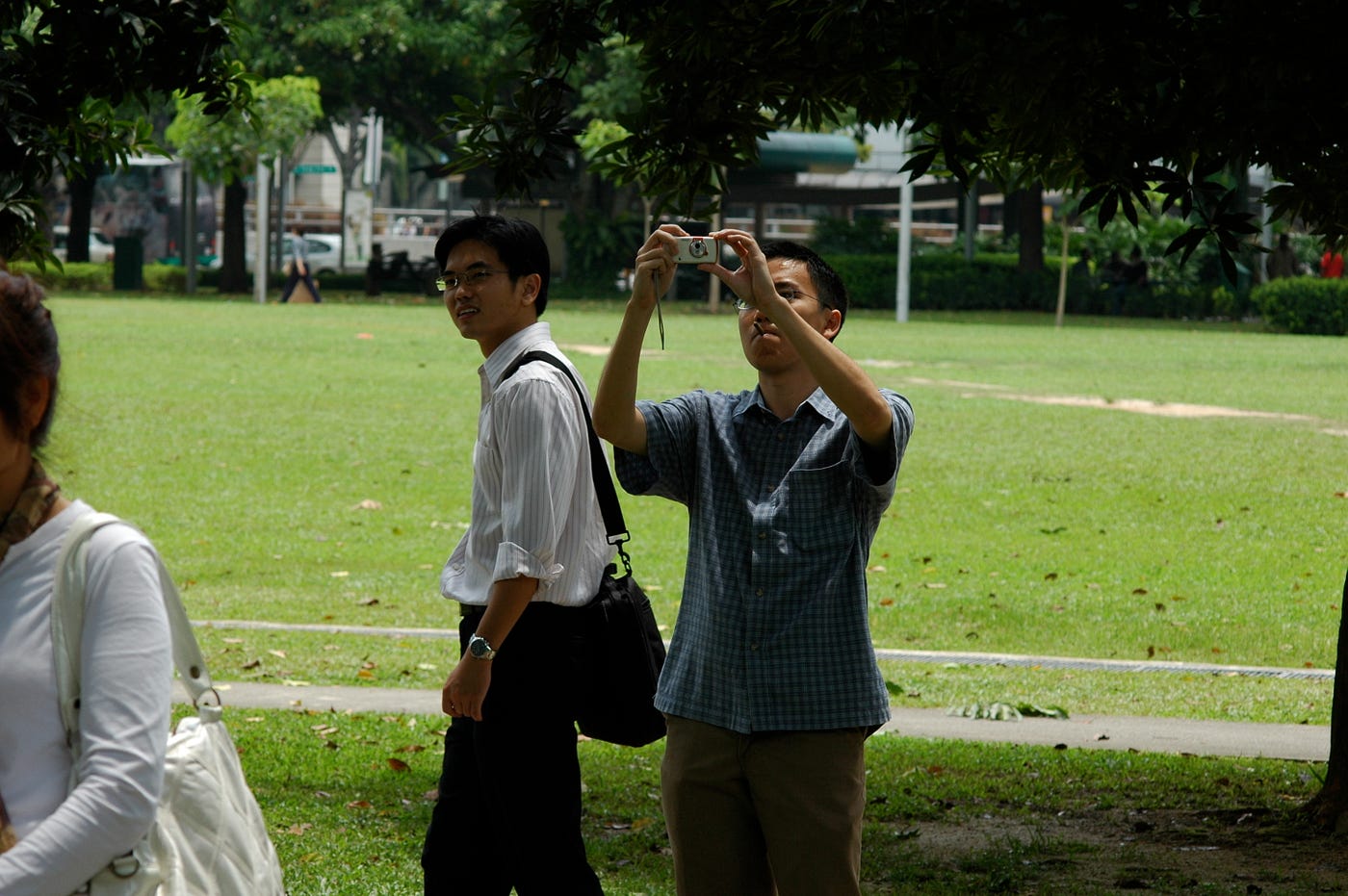
Singaporean Internal Security Police recording our every move, Singapore. 2006
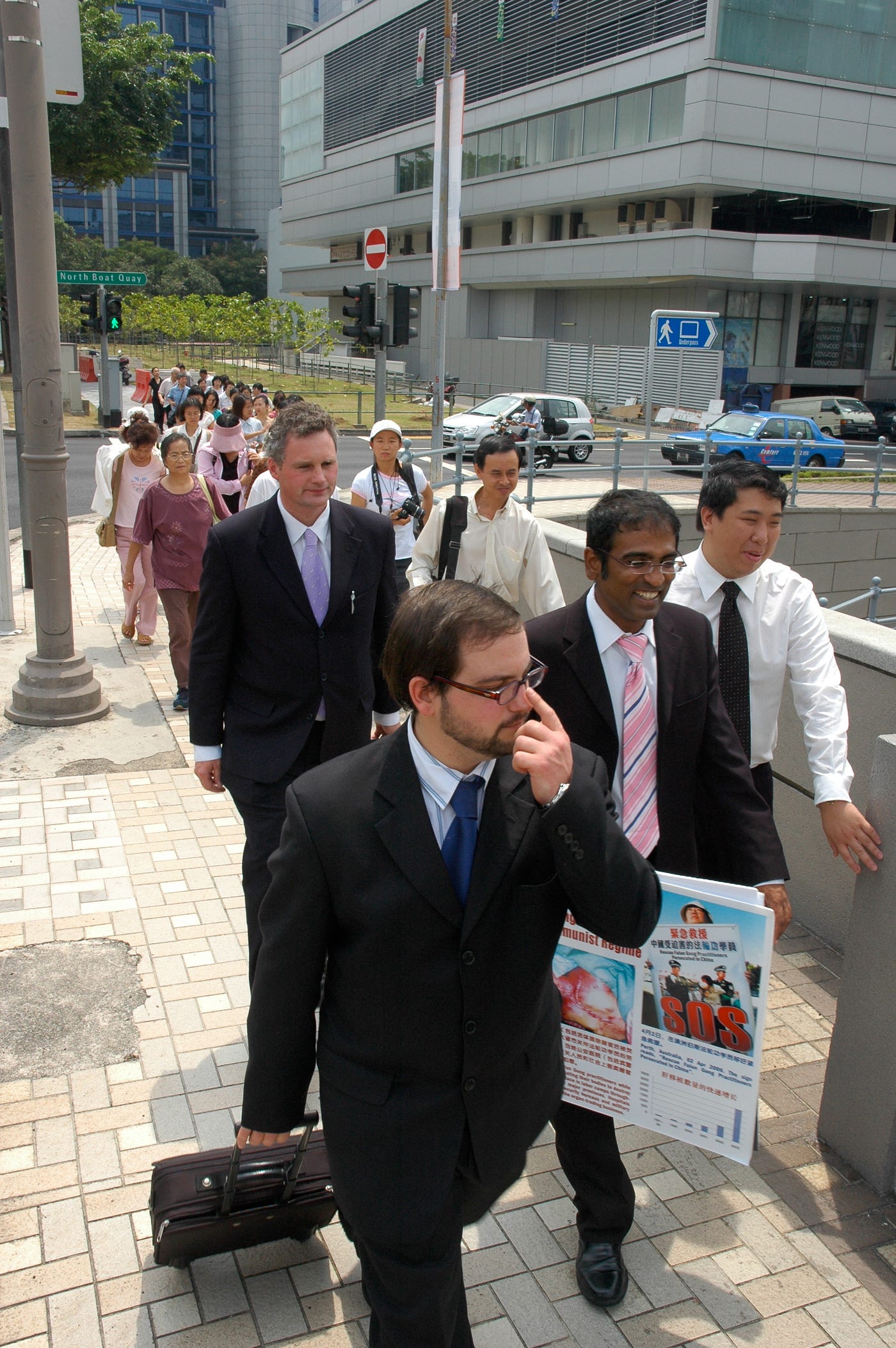
Marching to the Appeal Court, Singapore 2006
Stephen Gregory the then Chief Editor of The Epoch Times asked me to cover the International Monetary Conference (IMF) and World Bank conference whilst I was there. This was my cover for entering the country whilst my actual role was acting as an attaché for M. Ravi, an award-winning human rights lawyer with undiagnosed bipolar at the time. My job was to sneak into the high court, witness the travesties of justice being carried out at the behest of the CCP and write a report to take back to the United Nations Human Rights Council (UNHRC) in Geneva the following month. M. Ravi was incarcerated in a mental institution the morning he was supposed to join me in Geneva as a witness. This was due to a manic episode that had started during the course of the trials I was following and concluded with his bipolar diagnosis. It certainly explained his wild actions and eccentricity. Unfortunately he died from a drug overdose in December 2025.
Life in Singapore was a stress-induced fever dream. I stayed with a local family in a high-rise, sleeping on a top bunk in the kids’ room. Between curry for breakfast and the shadow of the Internal Security Department (ISD), I managed to propose to my future wife via a survey. Romance wasn’t dead: it was just a multiple-choice format.
The court cases were harrowing. I watched the state execute a young Nigerian boy despite him being declared innocent, purely to appease political interests. I saw Falun Gong practitioners prosecuted for “embarrassing” the Chinese embassy by meditating. It was a rapid blur of international flights and profound humiliation. I flew to Geneva for the UNHRC meeting, sleeping on the floor of another practitioner’s flat where the shower was literally in the kitchen. Glamorous it was not.
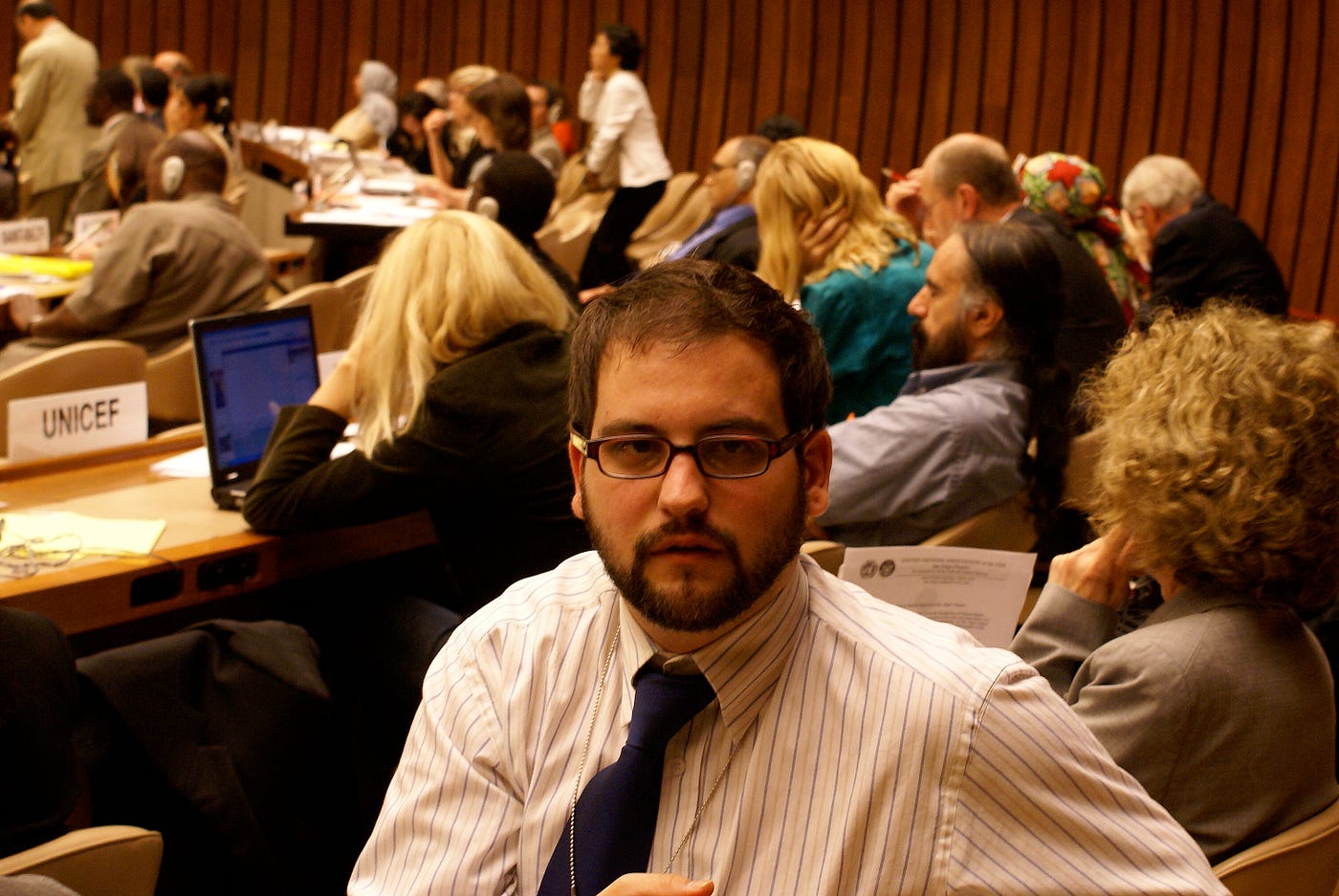
Waiting to present my evidence from Singapore at the UNHRC, Geneva, 2006
After being patted on the back for a good job at the UNHRC, I was encouraged to go back to Singapore to continue my work and look in on Ravi to see if I could help him. When I got back into Singapore, I was immediately detained with illegal immigrants and prostitutes. I was a political hot potato and no one wanted to handle me. I was eventually deported to Australia under the watch of an Air Marshal, interrogated for hours as a potential terrorist or drug dealer, and then deported again to New Zealand. In Auckland, I was chucked into jail overnight before being deported back to the UK with nothing but a suitcase.
I moved back into my dad’s flat in Islington: broken, exhausted, and financially ruined. I had given my skills, my freedom, and my sanity to a cause that saw my suffering as “karma being eliminated.” The peaceful qigong in the park was dead. I was a professional devotee, a brainwashed foot soldier, and the trap had finally sprung shut.
The Performance Art of Failure
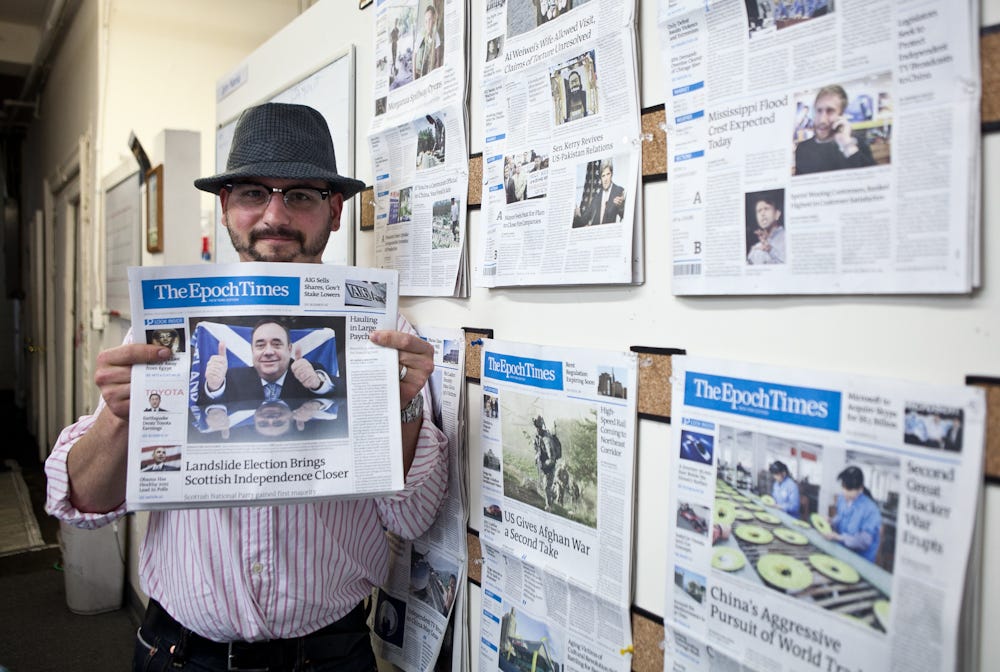
At the Epoch Times headquarters on 27th St, Manhattan.
Working for The Epoch Times was less a media career and more an avant-garde performance art piece about organisational failure. The headquarters on 27th Street, Manhattan, was a hub of frustration where no one got paid unless they were the chosen few pushing ad space. Most of the staff lived in dingy missionary dorms, existing on the smell of an oily rag and whatever food was donated to the communal kitchen. There was always Chinese food, supplemented by industrial-grade Western sustenance: specifically, bucket-sized containers of peanut butter that vanished faster than a Master’s prophecy about a celestial cleansing.
My promised accommodation in New York turned out to be a first-floor brownstone apartment near the Bedford-Stuyvesant subway station. The living room had been converted into a dormitory for about a dozen young men under the age of thirty: I was the oldest by a long shot. On my first night, I had one of my shouting nightmares, which understandably freaked out the local demigods. They eventually cleared out a storage room for me, likely out of pity for my age and probably a certain respect for my “position” within the Epoch Times. The common area was a small dining table next to the kitchen, it was as basic as a prison. This was certainly not the professional setup I had been sold when Jan Jekielek (a senior editor at The Epoch Times) convinced me to fly over and become the Global Marketing Director..
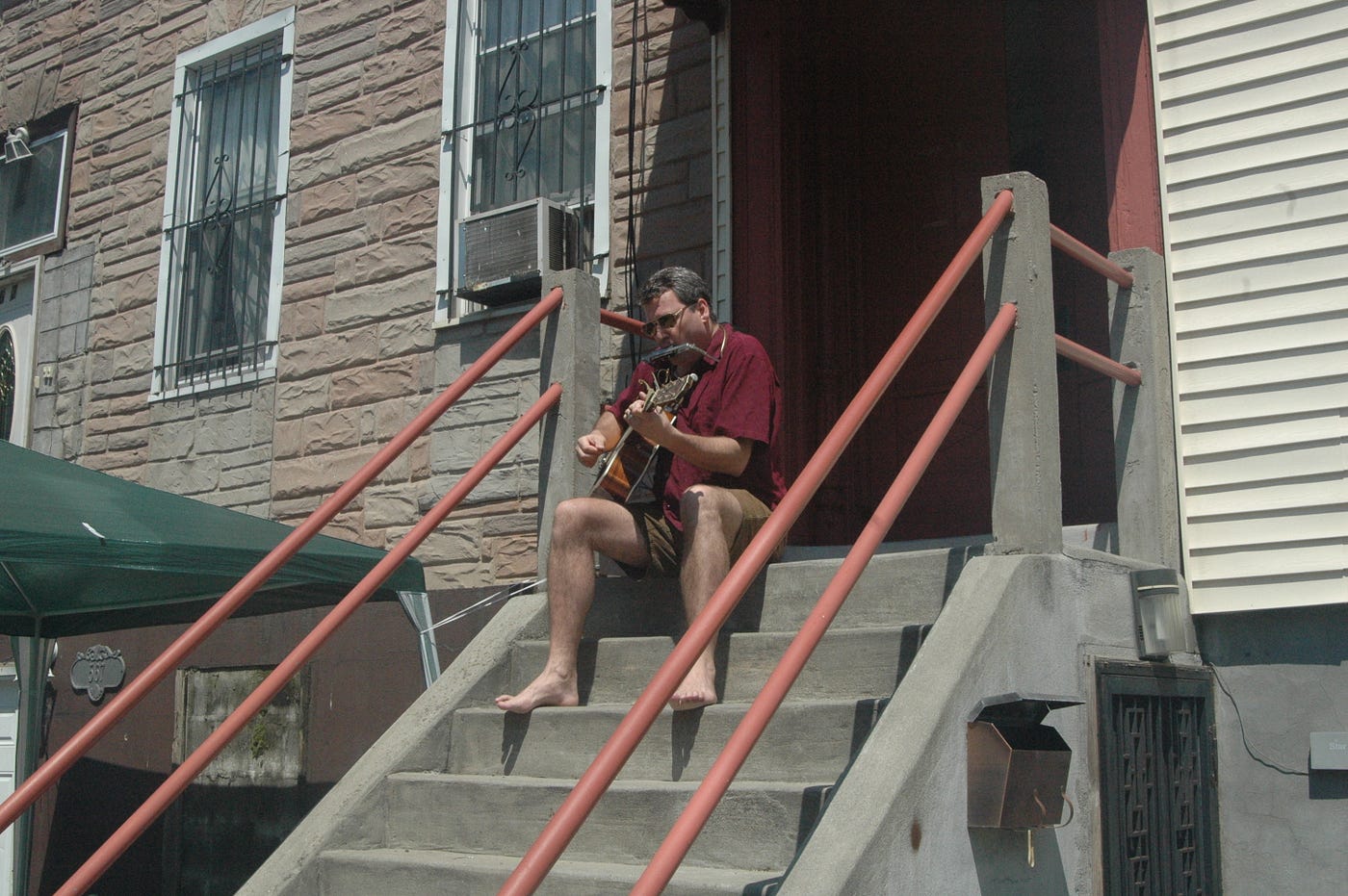
Practitioner playing guitar on the steps of our brownstone dorm. Lafayette Avenue, Bedford Stuyesant, 2011.
The Global Marketing Director vs. The Dunning-Kruger Effect
As the Global Marketing Director, a role I was actually professionally trained for, I was in a permanent staring contest with the Dunning-Kruger effect. Every practitioner believed they were the God of their own paradise, meaning they were far too “spiritually advanced” to follow my “everyday people” marketing directions. I would present a basic strategy and watch it sail over the heads of clueless academics who treated business meetings like meditation retreats. It was less a workplace and more a kindergarten run by newly self-actualised deities. I felt like I was banging my head against a wall, only the wall was composed of serene, unearned spiritual superiority.
Professionalism was an alien language. The organisational handbook, had it existed, would have been a list of broken laws regarding tax, labour, health, and safety. We had no health insurance because we were too busy saving sentient beings to worry about mortal concepts like emergency room access. This belief that our “noble cause” superseded all earthly laws was the only functional policy the company had.
The entire operation was driven by a spiritual mission: saving sentient beings from a cosmic reckoning. We maintained a façade of being an independent news organisation, even hiring a few non-practitioners for the look of it, but the editorial line was dictated by the Master’s latest teachings. The paper was officially started on May 20, 2000, by John Tang, and it was just one-third of the Master’s media trident, working in lockstep with NTD Television and the Shen Yun Performing Arts company.
I hated Shen Yun from the moment it arrived. Artistically, it was little better than a Disney on Ice kids’ show: tacky, gaudy, and full of blunt propaganda. Li Hongzhi told us that every person who saw the show would be saved, a claim I didn’t buy for a second, but I went along reluctantly. I am embarrassed and annoyed that I spent years shilling for this charlatan.
Any genuine accomplishment was a miracle of individual heroics, as the titular heads: Chairperson Dana Cheng and President Thomas Houston, offered no discernible direction. Houston was a nice guy but a rubbish leader and a former CIA agent. Concepts such as having a business strategy were pointless because it all came straight from the top, passed down through mouthpieces to ensure Li Hongzhi maintained plausible deniability. The absurd goal to replace the New York Times came directly from Li in 2009. When I pointed out that the Times spent $70 million a year on journalism alone, my reality check was ignored. We were perpetually scrambling to pay for ink while being told to “think bigger”.
The Heist and the Earthquake
If you want to leave a cult, you don’t just hand in your notice and get a farewell morning tea with a stale lolly cake. You have to plan it like a prison break, with the kind of logistical precision that would make a heist movie look amateurish. By 2011, I had been PIMO for years: performing the required spiritual gymnastics while my soul was basically screaming for the exit. I was the architect of the Epoch Times marketing, but I was also the primary victim of my own campaign.
The opportunity for my final act of defiance came from a tectonic shift halfway across the world. In 2011, a devastating earthquake ripped through my wife’s home city of Christchurch. To most people, it was a catastrophe; to me, it was a literal act of God or at least a very convenient movement of the Indo-Australian plate to finally leave New York. I used the chaos and the genuine need to support my wife’s family as my “get out of jail free” card, finally escaping the suffocating fantasy bubble that had consumed thirteen years of my life.
Moving to New Zealand was supposed to be the clean break, the moment I stopped being a shill for a charlatan who claimed he could fly and that aliens were using computers to take over our bodies. But the tentacles tried to drag me back. Even in the sanctuary of Aotearoa, I found the machinery of the movement whirring in the background. When local reporter Michael Morrah started publishing the actual truth, the cult dispatched a handler named Daisy all the way from New York to harass him. They are a machine, and the means of “saving people” always justifies the relentless human cost.
The Part-Time Job That Pays in Karma
The mental burden of being a practitioner was a relentless, exhausting grind: a schedule designed to consume every available minute and supersede normal human responsibility. The “peaceful” qigong in the park was merely the hook for a lifestyle that turned every day into a marathon of spiritual duty. The minimum cultivation schedule was essentially a part-time job that paid in “karma” instead of cash:
- Standing Qigong Exercises (1 hour): Holding specific, often painful hand poses for fifteen minutes each.
- Meditation (1 hour): An hour of agonizing double-lotus meditation, which for any length of time felt like pure torture.
- Reading (1.5 to 2 hours): Reading one chapter of Zhuan Falun. It wasn’t strictly mandatory, but in a group setting, it was absolutely expected.
- Sending Righteous Thoughts (1 hour): Chanting FZN four times a day for fifteen minutes a session. I hated this ritualistic, compulsory praying.
- Clarifying the Truth: Protesting in public at every opportunity, especially on weekends, eating up any potential downtime.
After all that, you were finally “allowed” to do “normal everyday people” things like sleeping or earning a living. The pressure was unrelenting. If you were tired, you weren’t cultivating well enough. If you were stressed, you clearly still had attachments. It was a cycle of performing sanctity while your internal compass was being systematically dismantled.
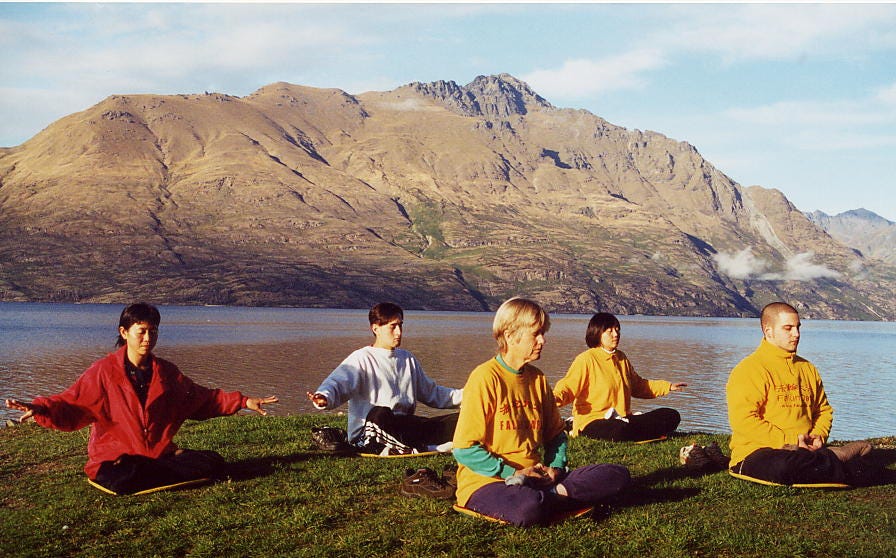
Meditating outside Queenstown, New Zealand. Circa 2002.
The Media Trident and the Sacred Cash Cow
This fearful worldview was cemented by a massive media machine. Outlets like The Epoch Times, NTD, and Sound of Hope radio were the Master’s “media trident,” driven by the mission of “saving sentient beings” and a deep-seated hostility toward the CCP.
The exploitation extended to the “sacred cash cow,” Shen Yun Performing Arts. Operating out of the sprawling Dragon Springs compound in upstate New York, Shen Yun was sold internally as the celestial key to saving the world. In reality, it was a gaudy, propagandistic mess. They recruited and exploited immigrant children, some as young as twelve, subjecting them to gruelling training and zero pay within an isolated community.
The irony reached its peak in 2024 when the news broke about the massive money laundering scheme tied to the organisation. The CFO, Weidong “Bill” Guan, allegedly laundered at least $67 million in criminal proceeds. It turns out that saving sentient beings is much easier when you are also funneling millions in crime proceeds from fraudulently obtained unemployment benefits.
Epilogue: Reassembling the Pieces
The aftermath of thirteen years of professionalised devotion is a special kind of mental wreckage. Since 2017, I have been in therapy trying to process the horrifying realisation that many of my thoughts and actions during those years were not actually my own. When you let a narcissist in upstate New York dictate your reality for over a decade, your internal compass needs a complete rebuild.
I am profoundly annoyed and embarrassed that I gave them my sweat, my skills, and my sanity. In return, I got a front-row seat to my father’s agonising demise. Watching him die of pancreatic cancer while he refused medicine because he thought his illness was just “karma” to be meditated away was the most painful experience of my life. The callous indifference of fellow practitioners who scolded me for my grief was the final nail in the coffin of my faith.
Today, I live in Christchurch, a 51-year-old survivor of multiple spiritual shipwrecks. I document this journey as an act of defiance. I volunteer for groups like Decult and Uncult Ōtautahi, using my experiences to warn others about the mechanics of the trap. The “peaceful” qigong in the park is a facade for a global empire that exploits the vulnerable and charges obscene prices to “save the world” through gaudy dance. I am still here, still reassembling the pieces of a life lived across two hemispheres. Learning to love yourself after being told your thoughts are mere “attachments” is the ultimate act of revolution.